
Book I: Youth along the Seine (1840–1861)
River Seine
Chapter 1: Rue Laffitte, Paris
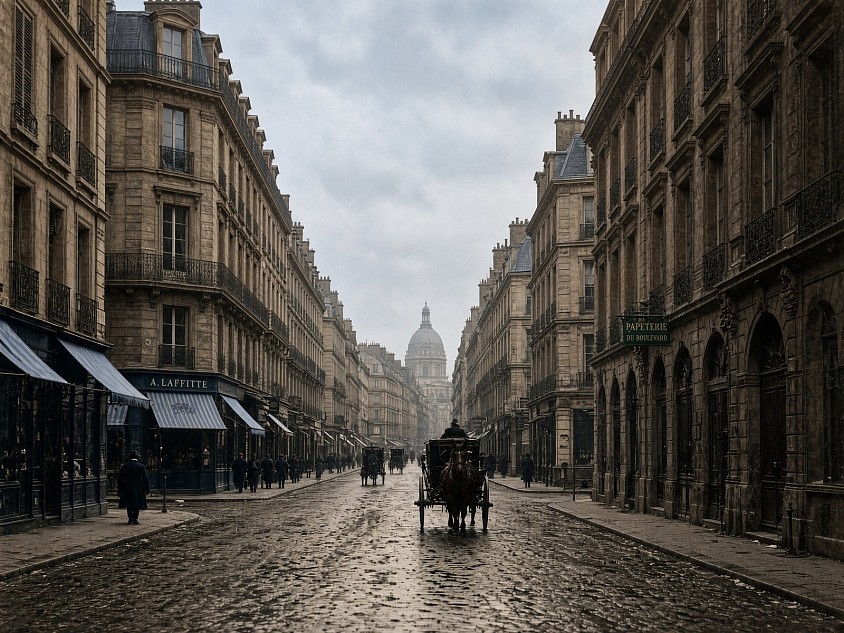
Rue Laffitte
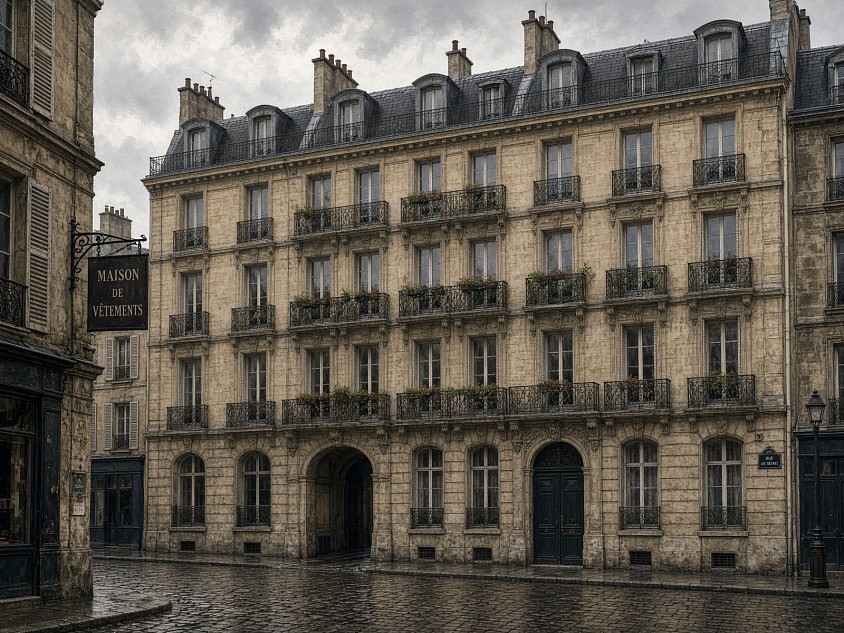
Rue Laffitte runs south from the new wealth of the quartier toward Notre-Dame-de-Lorette, whose façade is still young, still pale, still convinced of its own marble. The neighborhood is a rumor of stone: Haussmann has not yet taken his compass to these streets. The old houses lean. The courtyards hold cisterns and cats and the sour perfume of cabbage water thrown from upper windows. A fiacre passes with a sound like wet drums. Somewhere a woman practices scales—Louise-Justine herself has a singer’s throat, and on better evenings the rooms fill with a line of melody that does not belong to colonial goods. She will be the one who does not flinch when charcoal appears on the margins of school copybooks. She will be the one who dies first. I walk the infant’s first night as one walks a coastline that has not yet decided whether it is harbor or wreck. Paris in 1840 is Louis-Philippe’s city, an umbrella city, a capital that wants the juste milieu and cannot quite keep its boots out of the gutter. Gas has begun; oil persists. The Louvre holds its dead kings and its living copyists. No one on rue Laffitte knows that the child in the fifth-floor room will one day stand before those same galleries and refuse them—refuse the brown studios, refuse the antique pose, refuse everything except the hour as it happens.
Rue Laffitte, no 45, 5th floor
I remain in the apartment long enough to learn its true geography. There is the room of the birth, which already wants to forget it was a theater. There is the kitchen, where a pot of soup thickens with the patience of the poor-enough, onion and bone giving the air a low brown smell that clings to the plaster. There is the window that looks not onto grandeur but onto the opposite wall’s soot and a slice of sky the width of a ledger column. Oscar, in the first weeks, is a digestive argument. He sleeps, wakes, claims the air with a cry that smells of warm salt, sleeps. Louise-Justine’s body learns him as instruments learn a new key. Adolphe learns the weight of a second son the way he learns a new supplier: by adding a line and hoping the margin holds. Winter tightens. The zinc speaks more loudly. In the chambers, men argue railways as if iron were a moral quality. In the south, the floodwaters recede and leave a brown scripture upon the walls of churches. On the ocean, the Belle Poule carries toward France a coffin that will make a nation feel briefly larger than its treaties. None of this knocks at number 45. What knocks is the water-cart, the baker’s boy, the concierge’s keys, the small engine of two sleeping children out of time with one another.
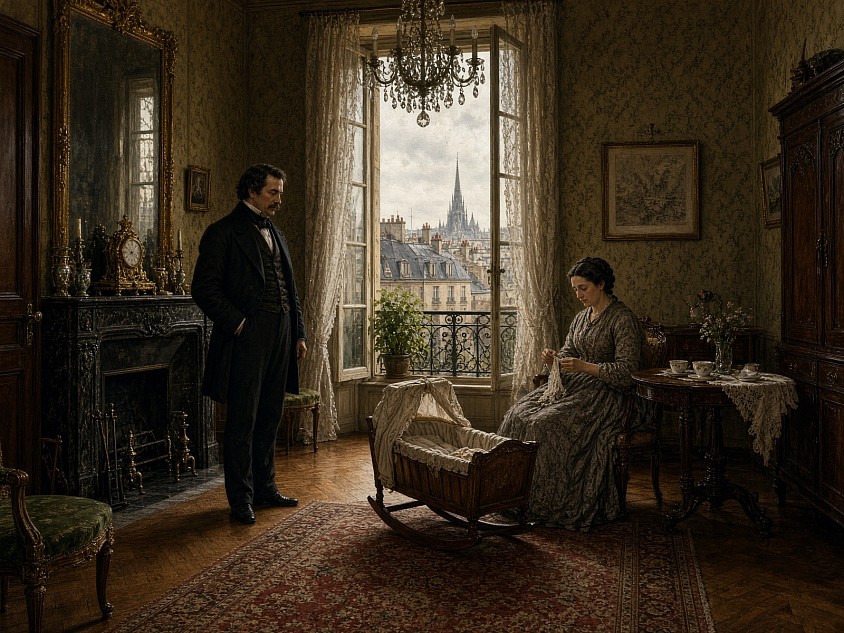
Rue Laffitte, no 45, 5th floor
Chapter 2: Chandler’s Harbor
In 1845 the ship-chandler is not a grocer who happens to keep extra stock; he is the priest of departures, the man who sells the objects without which a hull remains only wood waiting for the first wave to prove it mortal. He measures rope by the coil that will later groan against winds no shopkeeper on the quay will ever stand under, canvas by the bolt that must hold a sky the inland merchant will never see, nails that are already promised to rust in latitudes whose names the grocer cannot pronounce, biscuits baked so hard they can break a tooth yet last through months of salt, vinegar to cut the sameness of preserved meat, slush lamps whose greasy light will burn in cabins far from any parish, blocks and tackle that multiply a man’s strength when the sea decides to test it, tar that seals what water would otherwise claim, and the small brass instruments sailors treat as gods of navigation because without them the stars remain mute. The shop is a nave of useful darkness. Light enters as if ashamed of its own brightness and leaves as if it has been given a lesson in humility. Coils sit like sleeping animals that will one day wake and pull against the whole Atlantic. Canvas leans like exhausted saints who have already carried more sky than flesh was meant to bear. The air itself is pitch and hemp and iron mixed with the sweet rot of sugar that has traveled farther than most prayers ever reach.
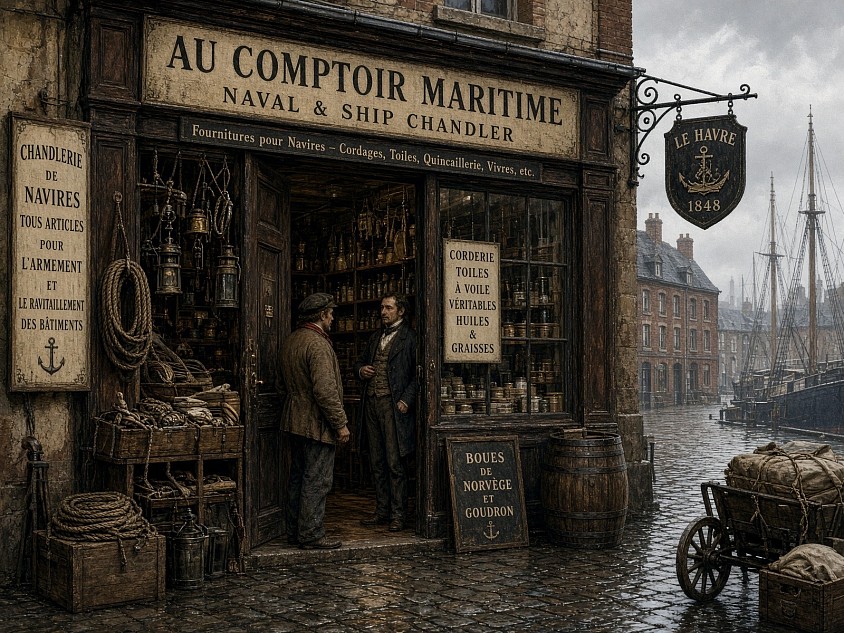
The Ship Chandler’s Store of uncle Jacques Lecadre in Le Havre
Fifth floors become ships
Fifth floors become ships
It is 1845. Oscar is five. Léon is nine. Louise-Justine packs the last of the linen with the concentration of a woman folding a life that will not unfold the same way twice. Claude-Adolphe has accepted the summons of blood and profit: in Le Havre, Jacques Lecadre—husband to Adolphe’s older half-sister Marie-Jeanne Gaillard—keeps a thriving house of ship-chandlery and grocery, a business that smells of tar, salt beef, lamp oil, sailcloth, and the sweet rot of colonial sugar. Arthur Lecadre, the nephew-partner, has died two years since; an opening has the shape of a grave and the temperature of opportunity. The capital has been a rumor of stone. The estuary will be a fact of water. Number 45 does not bless them. Houses never bless departures; they only sweat a little more, as if effort were a kind of farewell. The banister still remembers other hands. The courtyard still throws up the sour perfume of cabbage water. A cat, creditor of all landings, watches the trunks go down with the indifference of those who have never signed a lease. The concierge counts the steps as she has always counted them, and finds that five flights remain five flights even when a family is subtracted. “Ships,” she says, not without the small triumph of those who stay. “I told you. Fifth floors become ships.”